
Michael Frank on Building a Brand Arou
Michael Frank is Vice President of Marketing at Arctic Walk-Ins, the food-service equipment manufacturer that designs and builds walk-in coolers and freezers for everyone from independent pizza shops to Marriott and Ritz-Carlton properties. His path there ran through entertainment marketing at Puma, co-founding an artist management firm for electronic musicians, building and losing a cannabis brand to COVID, and running a growth marketing agency, before Arctic Walk-Ins, one of his agency’s own clients, brought him in-house two years ago.
In this “Beyond the Brief” Conversation, Michael discusses why a “commodity” box is anything but simple to sell, how Arctic balances trade shows with digital demand generation, and why a chef’s unscripted testimonial might be the brand’s most valuable asset.
A circuitous path to cold storage
Q: You’ve had one of the more unusual paths to industrial marketing we’ve heard: entertainment, artist management, cannabis. How did you land at a walk-in cooler manufacturer?
Michael: It’s been a circuitous path, to be honest. After college, I moved to LA thinking I’d produce films, and ended up in entertainment marketing at Puma instead: product placement, celebrity seeding, music events. I co-founded an artist management firm in electronic music for a few years, but I realized I didn’t see myself surviving the industry into my 40s, so I went back into marketing, brand management, social strategy, mostly in fashion and retail. I built cannabis brands in the Pacific Northwest and British Columbia, then started my own in California, which was ill-fated because of the challenges of operating a start-up in a highly regulated industry during COVID. More recently, I was the Managing Partner at a growth marketing agency, and one of my first clients was Arctic Walk-Ins. About two years ago, they asked me to come in-house, and it’s let me combine everything I learned at every stop – social, digital, brand, product, content, experiential – all into one job.
Selling complexity behind a “commodity”
Q: On the surface, a walk-in cooler looks like a simple box with a chiller. What are people missing?
Michael: Everything, honestly. What we manufacture is consistently the same thing – foam-injected panels with metal skins, powered by refrigeration – but the application is never simple. A food bank palletizing thousands of pounds a day needs a floor with sufficient integrity to withstand electric pallet jacks. A general contractor doing seismic work in California needs something completely different from hurricane engineering in Miami or snow-load requirements in New York. Then there’s A2L refrigerant regulation, mandated by the EPA and now being rolled back differently state by state, so we’re constantly adapting to what’s cheaper versus what’s compliant. It’s not a one-size-fits-all product, even though it looks like one from the outside.
Trade shows earn their keep, just not on a quarterly clock
Q: You’re doing more trade shows, not fewer, at a time a lot of B2B marketers are pulling back. Why?
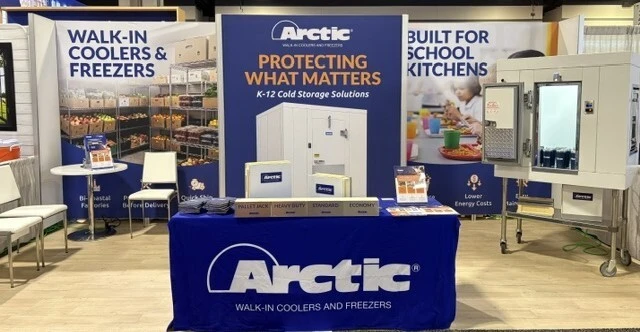
Michael: We see the ROI on a longer through-line than an immediate sales driver. You can’t be there from a relationship standpoint; food service is a genuinely family-driven business, dealers whose fathers did this before them, reps who’ve taken over family lines, and you never know who you’ll meet. We’ve done bigger booths with custom boxes to showcase finishes and design, and smaller ones with a tiny “mini cube” cooler that’s always a hit. But we pair that with a real digital funnel, demand gen, SEO, thought leadership, and we just reimplemented our CRM, so we’re building a full-funnel system that enables us to have total visibility into the pipeline. The in-person trainings we’ve ramped up with dealers matter too; there’s no substitute for a tactile experience with the product in someone’s hands.
Turning an unsexy category into a brand
Q: How do you build brand equity for something most people never think about until it breaks?
Michael: We’re leaning into it more. At a show recently, a chef walked by, stopped, saw our branding, and said on camera, unprompted, “Arctic, the best box I’ve used for 20-plus years.” That’s more valuable than anything we could put in a brochure. People also recognize walk-ins now because of the TV show The Bear; there’s a cultural relevance to the category that didn’t exist before, and I want to tap into that more deliberately. We’re also transforming as a company. We’re moving beyond being just an engineering-and-manufacturing-led entity to allowing sales-and-marketing to drive demand, which is a significant mindset shift. We’re investing in factory capacity, cutting lead times, and building state-of-the-art software that includes partner portals for up-to-the-minute insights on all their projects. And now we’re refreshing our brand and web presence so we’re set up for growth, heading into 2027 and beyond.
Michael Frank is Vice President of Marketing at Arctic Walk-Ins, the walk-in cooler and freezer manufacturer headquartered in Miami – he works remotely from Los Angeles. Before Arctic Walk-Ins, he built brands in fashion, retail, entertainment, and cannabis, and briefly managed artists in electronic music, a chapter he’ll only half-confirm includes a cameo on a well-known artist’s album cover. Connect with him on LinkedIn to learn more about his approach to brand-building in one of B2B’s least glamorous, most relationship-driven categories.